


























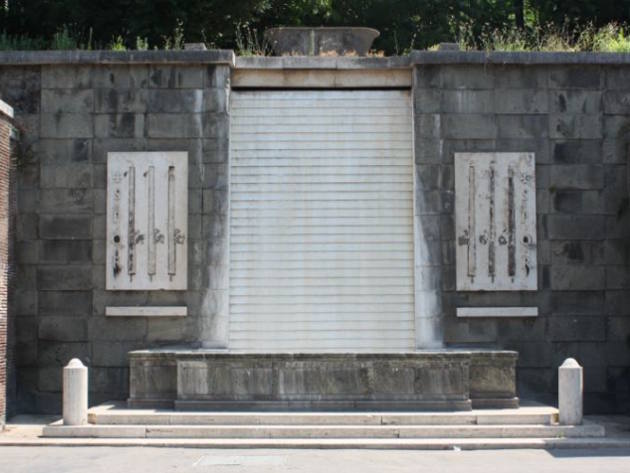
Inserted into the retaining wall of the Antiquarium, on the slopes of the Celio hill, in correspondence with the basin fountain above, the Fountain of via di San Gregorio, designed by the architect Antonio Muñoz (1884-1960) and inaugurated in 1933, is part of the larger development of the area, characterised by the Municipal Antiquarium (reopened in 1929) and the widening of the road - then called via dei Trionfi, today via di S. Gregorio - from the Arch of Constantine to piazzale di Porta Capena, envisaged in the 1931 master plan.
The fountain, whose vertical section consists of a marble "shutter" structure, over which water flows in a cascade effect, is framed by two massive brick propylaea; the water flows into the rectangular serpentine basin with recesses on both sides. The support surface is composed of three travertine steps, bordered at the corners by travertine columns. On the back wall, characterized by smooth peperino ashlars, two marble plaques, originally decorated with fasces - later chiseled - and the inscription S.P.Q.R. in raised capital letters, are placed on either side of the waterfall.
In designing the fountain, the architect appears to have drawn inspiration from a type of fountain from Northern Europe, creating a basin that somehow resembles them.
Photo: Fountain on via di San Gregorio, photo by Capitoline Superintendence of Cultural Heritage
The Roman Forum and the Palatine
 Condividi
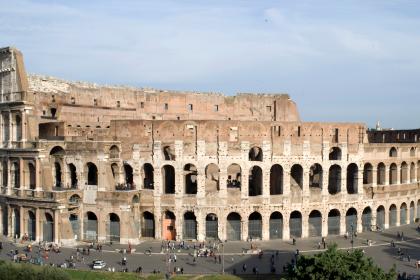
The Flavian Amphitheatre (The Colosseum)
 Condividi
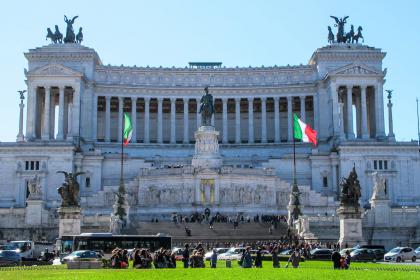
Piazza Venezia
 Condividi
Information
Condividi
Location
To find out about all accessibility services, visit the Rome accessible section.