





















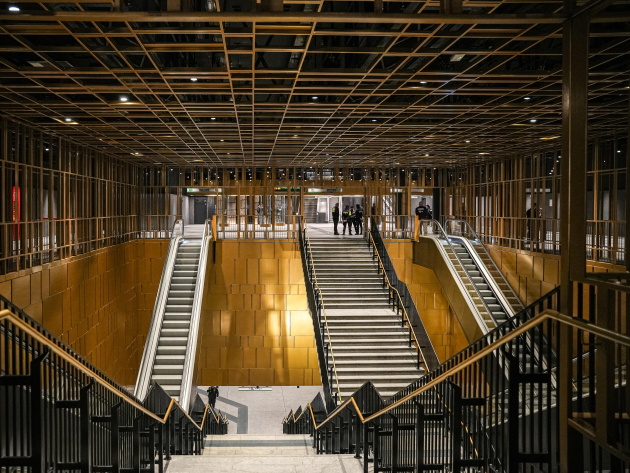
Rome takes a further step forward in urban mobility with the opening of the Colosseo–Fori Imperiali and Porta Metronia stations on Metro Line C. These are true museum-stations, designed to preserve and showcase the archaeological discoveries unearthed during excavations along a stretch of around four kilometres, within one of the world’s most complex and fascinating underground environments.
The extension of Line C strengthens the connection between the south-eastern and north-western areas of the capital. The line now comprises 24 stations over 22 kilometres, running from the Monte Compatri/Pantano terminus to the historic city centre, helping to make urban mobility more efficient and sustainable.
To address the extraordinary challenges posed by Rome’s underground, an advanced construction technique has been adopted: archaeological top-down construction. Developed specifically for the historic city centre, this method allows excavation to proceed from the top down, with floor slabs constructed progressively, ensuring structural safety while enabling the continuous continuation of archaeological investigations.
Porta Metronia: a station among the Aurelian Walls
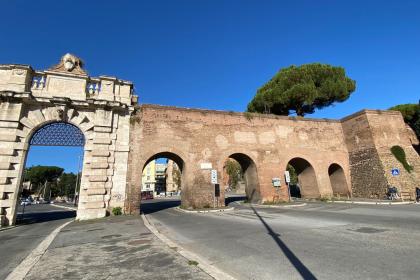
Located in Piazzale Ipponio, beside the Aurelian Walls, Porta Metronia station stands in an area of outstanding historical value. Excavation reached a depth of 30 metres, and the station extends across five underground levels. The spaces feature two entrances and a museum-style atrium, enhanced by screen-printed panels illustrating the finds and historical stratifications revealed during construction.
Colosseo–Fori Imperiali: when the metro dialogues with monuments
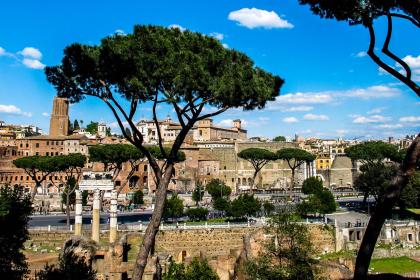
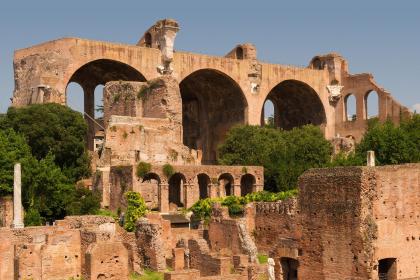
Situated along Via dei Fori Imperiali, between the Colosseum and the Basilica of Maxentius, Colosseo–Fori Imperiali station blends harmoniously into an iconic monumental landscape. The structure comprises four underground levels, reaching a width of up to 50 metres and a depth of approximately 32 metres.
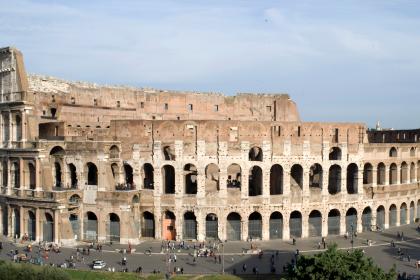
At the foot of the Colosseum, a true archaeo-station takes shape, featuring an internal museum display curated and funded by the Parco archeologico del Colosseo, in collaboration with Sapienza Università di Roma – Dipartimento di Architettura e Progetto. The route guides residents and visitors alike on a unique journey through history, from the entrance down to the platforms, transforming the wait for the train into a distinctive cultural experience. Of particular significance is the direct interchange with Line B, which further strengthens the integration of the metro network at the city’s central hub.
 Condividi
Via dei Fori Imperiali
 Condividi
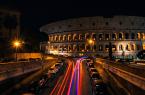
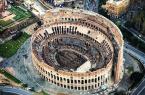
The Flavian Amphitheatre (The Colosseum)
 Condividi
Basilica of Maxentius
 Condividi
The Aurelian Walls
 Condividi
Porta Metronia
 Condividi