











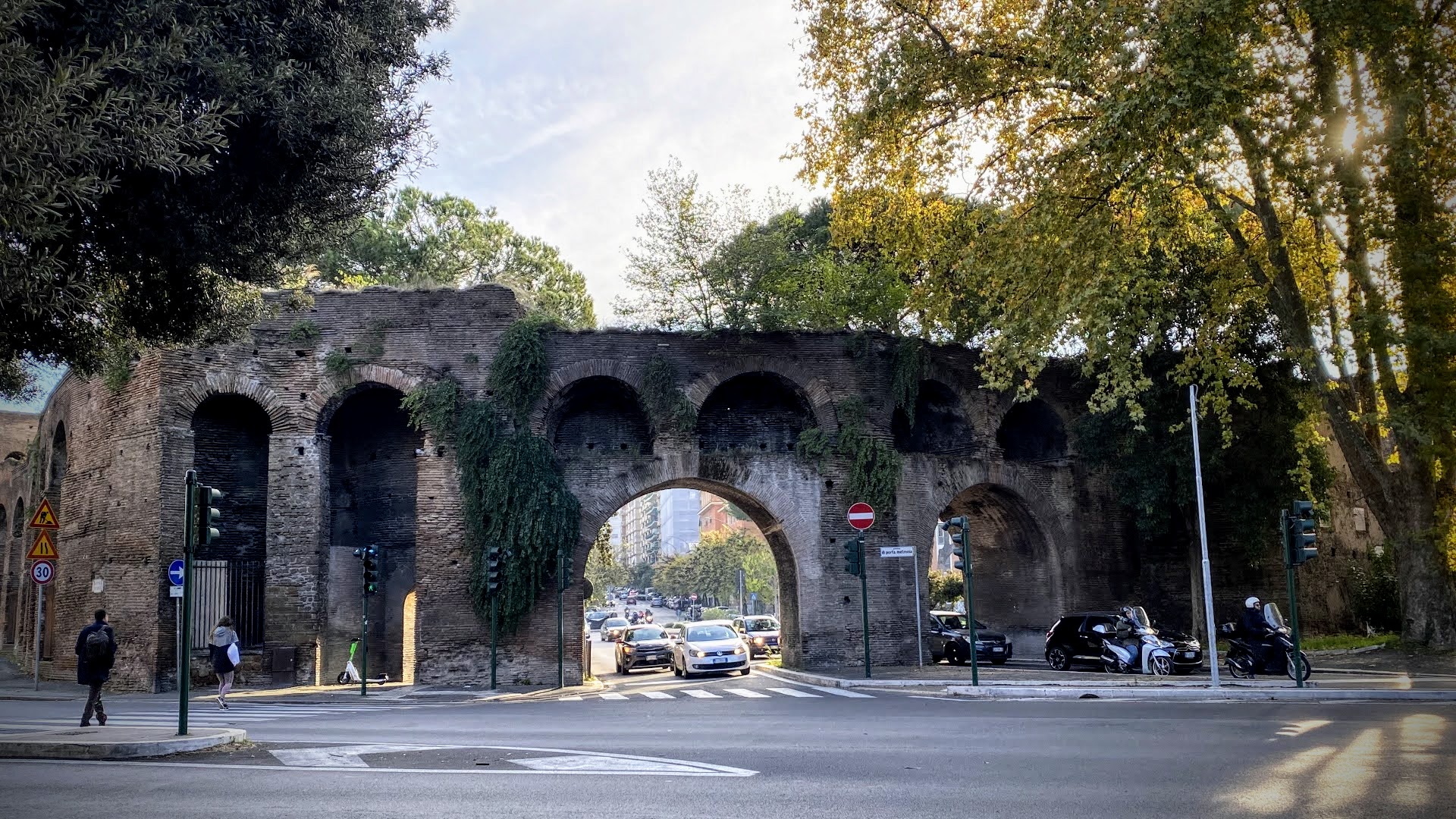
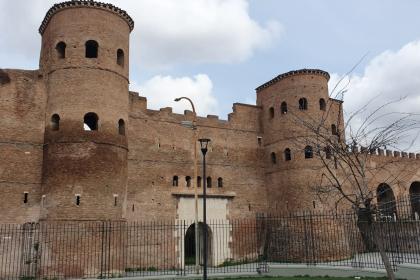
Among the many gates opening in the majestic Aurelian Walls, equipped with crenellated towers, celebratory inscriptions and defensive arrow slits, Porta Metronia stands out for its extreme simplicity: a single archway, devoid of ornament and marble decoration, cut directly into the brick curtain wall, protected by the same walls which, in this section, followed the steep natural slope of the terrain.
Originally conceived as a third-rank posterula – a minor passage intended for practical rather than ceremonial use – and, unlike other “lesser” gates such as Porta Pinciana or Porta Asinaria, which were restored and fortified around 402 AD by Emperor Honorius, it was never elevated to the status of a monumental entrance. It always remained a functional gate, “visible” only when required.
Perhaps it was precisely this incompleteness that also made its name uncertain. Over the centuries it changed several times: Metrodia, Metrone, Metiana, Metromia, Metrobi, Metrovia, probably derived from Metrobius, a landowner; Gabiusa, because from here one travelled towards Gabii; Metaura in the Middle Ages, from meta aurum, the place where gold from imperial taxes was weighed – an evocative idea, though unsupported by documentary evidence.
In 1122, Pope Callistus II decided to route the Aqua Mariana (also known as the Marrana di San Giovanni), an open-air water channel originating in the Squarciarelli area near Grottaferrata, through Porta Metronia. Already little used and in poor condition, the gate was closed to pedestrian and commercial traffic and transformed into a fortified water passage, carrying water that supplied gardens, mills and productive activities, before eventually flowing into the Tiber near the Cloaca Maxima.
A curiosity: along its urban course, the Marrana powered fourteen mills, known as mole di terra – a true medieval industry avant la lettre.
The water, however, also brought problems. The area outside the gate became known as “lo Pantano” (“the marsh”), due to stagnation caused by the Marrana, which over time turned the area into a swampy and unhealthy zone, so much so that in 1601 a severe epidemic spread through the surrounding districts.
In the twentieth century, with the creation of the Archaeological Promenade, the entire area was reclaimed. The landfill used to create the park raised the street level, buried the Aqua Mariana channel, and transformed Porta Metronia into what we see today, with the four lateral arches, opened between the Fascist period and the post-war years, which now serve modern urban traffic only.
On the inner wall of the gate survive two extraordinary inscriptions.
The older one, dated 1157, commemorates the restoration of the walls carried out by the Senate and People of Rome and reads in full: “TORRIONE DELLA PORTA REGIO S. ANGELI. + ANNO MCLVII INCARNATIONIS DOMINI NOSTRI IESU CHRISTI S.P.Q.R. HEC MENIA VETUSTATE DILAPSA RESTAURAVIT, SENATORES SASSO, IOHANNES DE ALBERICO, ROIERI BUCCACANE, PINZO FILIPPO, IOHANNES DE PARENZO, PETRUS DEUSTESALVI, CENCIO DE ANSOINO, RAINALDO ROMANO, NICOLA MANNETTO.” That is: “Tower of the Gate, Region of St Angel. + In the year 1157 of the Incarnation of Our Lord Jesus Christ, the Senate and the People of Rome restored these walls, ruined by age. The senators were Sasso, Giovanni di Alberico, Roieri Buccacane, Pinzo Filippo, Giovanni di Parenzo, Pietro Diotisalvi, Cencio di Ansoino, Rainaldo Romano and Nicola Mannetto.” This inscription is of immense political value and represents a true declaration of independence. At the height of the conflict between the Papacy and the Commune, the senators had their intervention engraved without even mentioning the pope, asserting the autonomy of civic authority over papal power.
The second inscription, dated 1579, records a new restoration privately financed by Cesare Giovenale Manetti, a descendant of one of the senators named in the medieval plaque. It reads in full: “GREGORIO XIII PONTIFICE MAXIMO CAESAR IUVENALIS LATINI F MANNETTUS COS III TURRIM HANC OLIM COLLAPSAM ET A NICOLAO MANNETTO VII VIRO SENATORE COLLEGISQUE EIUS QUORUM FAMILIAE EXTINCTAE SUNT INSTAURATAM RURSUS POST ANNOS CDXXI ITERUM COLLABENTEM UT PUBLICUM MANNETTAE FAMILIAE IN PATRIAM PERPETUAE VOLUNTATIS EXTET MONUMENTUM PRIVATA IMPENSA RESTITUIT ANNO SALUTIS MDLXXIX.” That is: “In the time of Pope Gregory XIII, Cesare Giovenale Mannetti, son of Latino, Councillor for the third time, restored at his own expense this tower, once collapsed and previously rebuilt by Nicola Mannetti, former senator, and his colleagues – whose families are now extinct – after it had again fallen into ruin 421 years later, so that it might stand as a public monument to the homeland, expressing the enduring will of the Mannetti family, in the year of salvation 1579.”
Photo: Turismo Roma
The Aurelian Walls
 Condividi
Porta Pinciana
 Condividi
Porta Asinaria
 Condividi
Information
Condividi
Location
To find out about all accessibility services, visit the Rome accessible section.