


















The Colosseum Archaeological Park opens the House of the Griffins to the public, the second of 10 projects included in the National Recovery and Resilience Plan Caput Mundi, part of Mission 1: Digitalization, Innovation, Competitiveness, Culture, and Tourism. This is one of the oldest Republican domus on the Palatine Hill, discovered by Giacomo Boni in the early 20th century, known for its perfectly preserved cycle of paintings and mosaics.
The project (sole project manager Federica Rinaldi, works manager Aura Picchione) was completed in December 2024, respecting the timeline set by the PNRR. The restoration and consolidation involved an integrated intervention including 3D photogrammetric surveys and restoration of the painted surfaces. Thanks to the allocated funds, it was possible to launch a scientific study and conservation project for the monument, both regarding the painted surfaces and its structure, given the evident signs of movement of the wall sections that occurred in ancient times, which had caused gaps in the walls, resulting in plaster losses and differences in height in the mosaic floor. In the following months, the lighting enhancement and audio-visual system for the real-time live tour, designed by Federica Rinaldi with the technical supervision of Stefano Borghini, were completed, thanks to the sponsorship of Comoli Ferrari, thus allowing the site to be permanently opened. In fact, visiting the underground portion of the site is only possible via a very steep staircase that is not accessible to everyone.
The House of the Griffins is conventionally dated between the late 2nd century BC and the mid-1st century BC; its discovery dates back to the excavations of 1912. The domus owes its name to the two large griffins (fantastic animals with the head of a bird and the body of a feline) in white stucco on red plaster inside the lunette of one of the house's underground rooms: the griffins, in a heraldic position and in profile, are placed in front of a lush acanthus bush. The house, spread over multiple levels that exploit the slope of the Hill, appears to be in an excellent state of preservation, as it was almost completely obliterated (and therefore preserved) from the early years of the Imperial age until the last great monumentalization of the Hill with the construction of the imperial palace of the Flavians (i.e., the Domus Augustana and the Domus Flavia). The massive foundations of the palatial complex pierced the two levels of the domus, cutting and dislocating the original plan, but effectively preventing further deterioration until its discovery. Today, the Republican rooms, although they have lost their original layout, retain the evocative legacy of at least three centuries of use, repurposing, and abandonment.
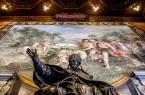
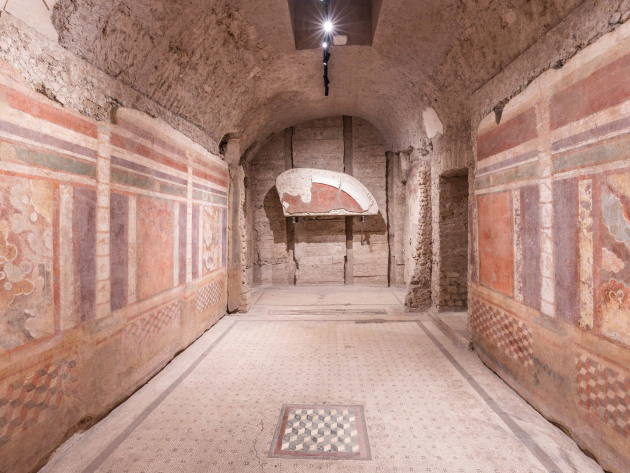
Of the domus's two levels, the lower, hypogeal level is accessible only by climbing a steep staircase. Eight rooms remain, with walls decorated with paintings combined with stucco, and mosaic floors made of white tesserae with black frames decorated with polychrome tesserae or inserts. The paintings, in particular, are considered among the best-preserved examples of illusionistic representations of architectural elements such as columns and pilaster strips, originally stuccoed but now skillfully painted. The most emblematic example is found in the decoration of the large central room, where the walls depict a colonnade on a projecting podium in front of a sequence of orthostats and mirrors of inlays and various marbles, recreating the illusion of elegant furnishings. The room, like all the others decorated with fine mosaic floors, is further enriched by a tessellated floor made of black and white tiles with a central pseudo-emblem bordered in antique red and decorated with perspective cubes obtained by combining white (palombino), green (marly limestone from northern Lazio) and black (slate) stone materials.
Photo: the Colosseum Archaeological Park official site
Informations
Le visite sono programmate tutti i martedì, a partire da martedì 3 marzo alle ore 14:00 (italiano) e 15:00 (inglese). L’accesso sarà consentito ai possessori di biglietti Forum Pass SUPER con l’integrazione della visita guidata pari a € 8.00.
SCHEDA TECNICA: COME VISITARE LA CASA DEI GRIFI
Date al pubblico Dal 3 marzo 2026
Giorni di apertura Martedì
Orario di apertura 14:00 e 15:00
percorsi didattici italiano 14:00
inglese 15:00 Modalità percorso didattico accompagnato
Biglietti Forum Pass SUPER Gruppi massimo 12 persone Durata 30 minuti
Ingresso Via Sacra, Arco di Tito
Meeting point Arco di Tito
 Condividi