













Rome in May, a month of unmissable events and visit opportunities. Find out what to do from 1 to 31 May 2026 and follow the suggestions thought up by our editorial staff to experience and admire the city, including along less beaten paths.
-
Roma Live events in May
-
New entries and special events in May
-
Rome free/low cost in May
-
Rome with kids in May
-
The days of Rome: key dates in the city’s history and traditions in May
-
The many facets of Rome: places of the ancient Rome, papal Rome and modern Rome to (re)discover in May
-
Itineraries and curiosities: our tips for May
Roma Live events
Roma Live is the calendar for experiencing Rome at 360°, a multimedia container dedicated to unmissable events for those living in the city and for tourists. Check here all the events for the month of May, navigating among the exhibitions, sporting events, concerts, theater shows, festivals, ballets and dance performances scheduled until 31 May. Please note: information available in this section is being updated constantly.
New entries and special events
-
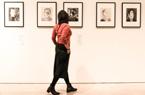
World Press Photo Exhibition - Today’s world through the work of photojournalists and documentary photographers from around the globe, covering major global events, the effects of the climate crisis, and intimate stories of resistance and resilience. From 7 May, Palazzo Esposizioni is hosting the travelling exhibition featuring the most dramatic and evocative images of the past year, selected by the independent jury of the World Press Photo Award.
-
Open House Roma 2026 - A total of around 300 free events (bookable online) spread over nine days. From 16 to 24 May, Open House Roma will once again offer a portray of the city through the lens of architecture and design. Its vast program spans eras and styles, opening to the public buildings not normally accessible to visitors, institutional venues and even private homes, both in the historic center and in more contemporary and less touristy areas.
-
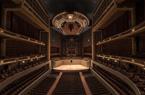
Tancredi - A rarely performed masterpiece composed by Gioacchino Rossini when he was just over 20 years old, set in medieval Sicily amidst the conflict between the Byzantines and the Saracens, and one of the most original voices in contemporary Italian theatre. From 19 to 29 May, the love story of Tancredi and Amenaide, thwarted by intrigue, war and reasons of state, returns to the Teatro Costanzi, directed by Emma Dante, winner of the Golden Lion for Lifetime Achievement at the 2026 Venice Theatre Biennale.
Rome free/low cost
Churches, palaces and fountains, courtyards and cloisters, elegant squares and secret piazzas, marbles and stones with a history stretching back thousands of years – even if you have a limited budget, the city does not skimp on its wonders. With the new pricing system, access to museums and monuments managed by Roma Capitale is free for all residents of Rome and the metropolitan city. For tourists and non-residents, on 3 May, as on every first Sunday of the month, both the national cultural sites and the museums run by Roma Capitale will open their doors to the public free of charge. On 31 May, as on every last Sunday of the month, entry will be free to the Vatican Museums (from 9 a.m. to 2 p.m., last admission 12.30 p.m.). There are also four small museums that are always free for everyone (Museo delle Mura, Museo della Repubblica Romana e della Memoria Garibaldina and Museo di Casal de’ Pazzi, from Tuesday to Sunday, and the Casa Museo Alberto Moravia, open on the second Saturday of the month), plus the FAO MuNe - Food and Agriculture Museum and Network (from Monday to Friday, with mandatory online reservation), Palazzo Sciarra Colonna (from Wednesday to Sunday) and Casa Pasolini (from Thursday to Sunday). On the last Friday of every month, it is possible to visit the Farnesina collection of the Ministry of Foreign Affairs and International Cooperation.
Free or low cost events and activities for the month of May include for example: the programming of Officina Pigneto (every Thursday), the Notte dei Musei (23 May) and IPER - Festival delle periferie 2026 (concerts, workshops, installations, performances, DJ sets, guided tours, talks and debates at various venues, 8-31 May); the film festivals (films in original version) Filmissimi - Il cinema tedesco d’autore at the Goethe-Institut (14 and 28 May), Some Like It Classic 2026 (12 and 26 May) and Cinemente. Rinascite (from 7 May), both at Palazzo Esposizioni (14 and 28 April); the seasonal opening of the Municipal Rose Garden and visits to the Japanese garden of the Japanese Cultural Institute (5, 7, 12, 14 and 15 May), the tours to the Ministry of Infrastructure and Transport’s Contemporary Art Collection (MIT Contemporaneo, 16 May), the visits and special openings of Archeologia in Comune 2026, the Malborghetto Arch and the Villa Cavalletti Oil Museum in Grottaferrata (24 May); the exhibitions Acrobats, fire-eaters and funfairs at La Vaccheria, Il volto delle Donne in the Sala Maccari of Palazzo Madama, Francesca Woodman. Lately I Find a Sliver of Mirror Is Simply to Slice an Eyelid at the Gagosian Gallery, Danh Vo at the Nicola del Roscio Foundation, Alla ricerca del tempo perduto at the Accademia d’Ungheria and Atlas Studios. Latefa Wiersch at the Swiss Institute in Villa Maraini; the May Day Concert, the concert by the local police band at the Antiquarium di Lucrezia Romana, the Festival Jazz Idea in the Sala Accademica of the Conservatorio di Santa Cecilia (3 and 17 May), the concert The Arlington Chorale e COR.MAX in the church of San Marcello al Corso (16 May) and the organ concerts in the church of Sant’Antonio dei Portoghesi (2, 16, 23 and 30 May). Find more tips on the cultureroma and informagiovani websites. Find more tips on the cultureroma and informagiovani websites.
Rome with kids
Museums to explore, educational workshops and readings, theme parks, theatrical performances and much more... Discover all the events dedicated to children scheduled for the month of May and unleash your imagination among surprising adventures, journeys through history, interactive itineraries and guided tours. Our Kids page is updated weekly: visit us again for new ideas!
The days of Rome: key dates in the city’s history and traditions
Rites, festivals, anniversaries and celebrations have always marked the life of the city, its inhabitants and its visitors: a dense calendar of fixed happenings dating back to past eras, but also to the present day, that define Rome’s identity. Discover with us some of the city’s old and new special dates and moments, with the most heartfelt or awaited occasions – or even simply the most curious ones for the month of May.
The many facets of Rome: places of the ancient Rome, papal Rome and modern Rome to (re)discover
The pagan Rome that was the center of one of the largest empires that ever existed; the symbol city of the Catholic religion shaped by the successors on the throne of Peter; the new capital of the Kingdom of Italy and then of the Republic. The history of an eternal city is inevitably made up of multiple narratives that intertwine with one another. Each month, we will introduce you to three places that show the different imagines of Rome through the centuries.
-
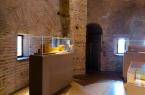
The Mithraeum of the Circus Maximus - Originated as an ancient Indo-Iranian deity, Mithras arrived in Rome around the time of Christ’s birth: promising his followers the certainty of a better life (both earthly and otherworldly) and aided by a widespread crisis of values, he quickly won the favor of many, particularly legionaries and soldiers. Protected also by the imperial household, at least until Constantine the Great, he would inevitably fall victim to the rise of Christianity, though not before leaving significant visual traces of his spread. Discovered in 1931, the Mithraeum of the Circus Maximus is one of the surviving places of worship among the over one hundred Roman shrines dedicated to the god. A relief and a slab preserved inside depict Mithras according to the iconography that has characterised him since the beginning: in the act of sacrificing the bull, whose blood fertilises the earth. Listed among the Monuments of the Territory, the Mithraeum can be visited on 16 May (with a guided tour) and on 20 May.
-
Villa Farnesina alla Lungara - On 6 May 1527, and for the seven months that followed, mercenaries in the pay of Charles V laid waste to Rome – days of chaos and devastation that, unexpectedly, left a visual record in the most refined residence of the Roman Renaissance. “Why shouldn’t I laugh, the Landsknecht have put the Pope to flight”: this sarcastic graffiti inscriptions is on the walls of the villa belonging to the fabulously wealthy banker Agostino Chigi, designed at the start of the century by Baldassarre Peruzzi and decorated with the magnificence befitting its status by, amongst others, Raphael, Sebastiano del Piombo and Peruzzi himself. The frescoes and rooms of the villa (now home to the Accademia Nazionale dei Lincei) can be admired on weekdays (from 9am to 2pm), every second Sunday of the month and online, via interactive tours. On 10 May, the villa will host the final concert of the Le domeniche di MuSa initiative (The Blues and more).
-
The Church of Sacro Cuore di Cristo Re - “Whatever your parishioners may think, I regard it, like so many artists and art connoisseurs, as one of my finest works”. These words, written in defense of “his” church, come from one of the most influential architects of the first half of the 20th century, the foremost exponent of the fascist regime’s monumentalist style. Inaugurated on 19 May 1934 and at the center of some controversy due to its modernist style (and even more so for Achille Funi’s apse fresco depicting a gigantic and disproportionate Christ on the throne, far removed from the tastes of the time), the church on Viale Mazzini had a complex genesis. It took fifteen years of work from the laying of the foundation stone on 18 May 1920, with a two-year hiatus on the building site due to a legal and financial impasse that led Marcello Piacentini to transform the new-baroque style of the initial design into the crystalline geometries of Italian Rationalism, stripped of all ornamentation.
Itineraries and curiosities: our tips
-
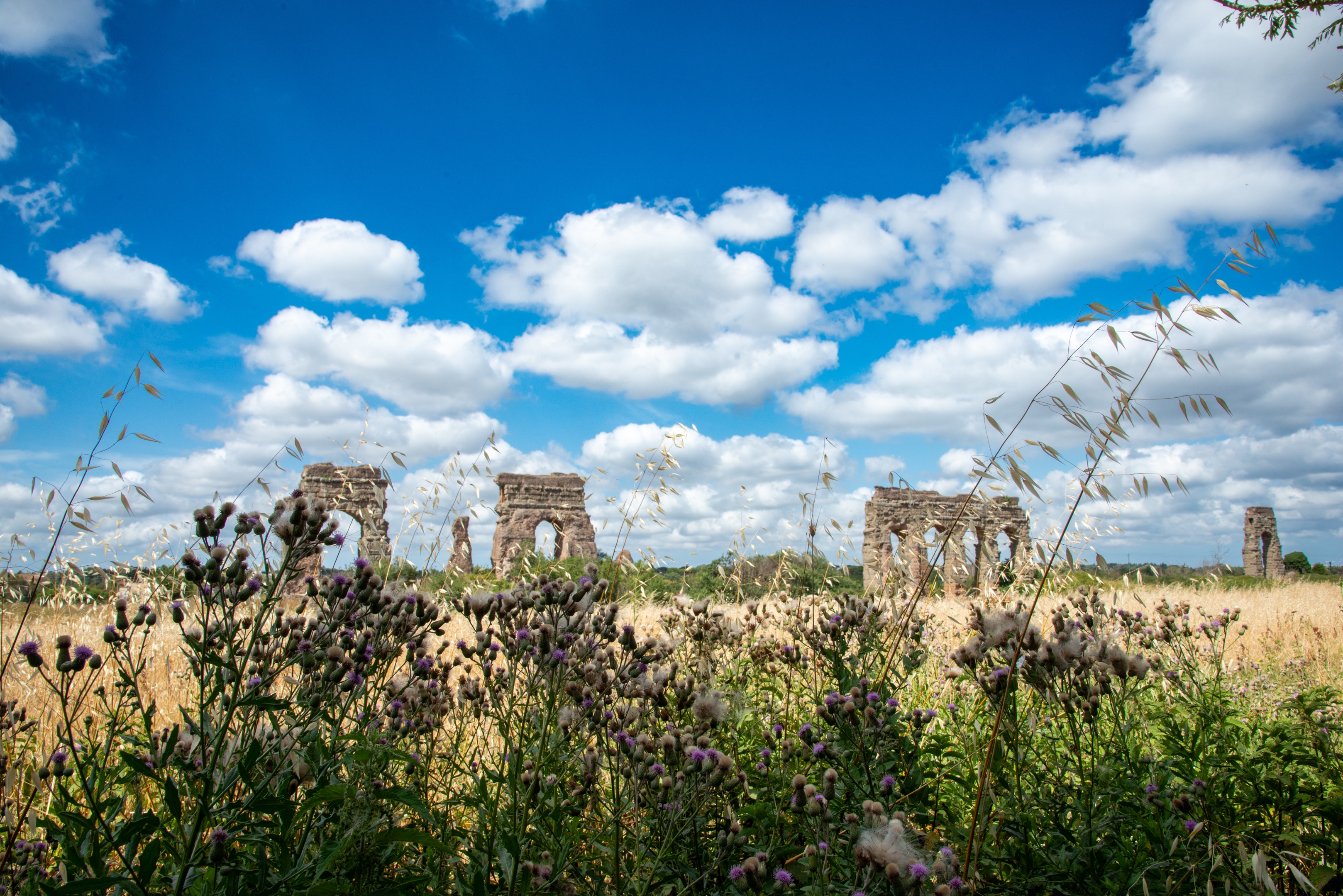
Water engineering: the Parco degli Acquedotti - A water-based civilisation founded on engineering prowess that finds its equal only in the modern world. Between 312 BC, when the Aqua Appia was built, and 226 AD, when the Aqua Alexandrina was completed, Rome came to have at its disposal around one million cubic meters of water per day, supplying homes, private villas and large thermal baths, as well as thousands of public baths and monumental fountains. All this thanks to 11 aqueducts, six of which (plus one modern one) run above and below the grassy surface of the Parco degli Acquedotti. Find out more in the dedicated page.
-
Caravaggio in Rome - It is 28 May 1606, and in a restless Rome, rife with passions, intrigues and power struggles, yet celebrating that day the first anniversary of the pontificate of Paul V Borghese, Caravaggio wounds (during a game of “pallacorda”, according to the chronicles) the troublemaker Ranuccio Tomassoni, who will bleed to death shortly afterwards. Pursued by the law, the painter is forced to leave the city where he had arrived as a teenager and which he had illuminated with his masterpieces, amid deep shadows and sudden flashes of light. Find out more in the dedicated page.