












The Three Fountains abbey complex stands in a small valley along the ancient via Laurentina. Legend has it that the abbey's name is linked to the martyrdom of the Apostle Paul, which occurred on June 29, 67 AD, near the Acque Salvie. Tradition holds that St. Paul's severed head bounced to the ground three times, causing three fountains of water to gush forth.
From the access avenue, one reaches the entrance to the complex, where stands the Arch of Charlemagne, presumably dating back to the time of Pope Honorius III (13th century) and with defensive functions. The building, with three arches in the lower part, is so called because, around the 13th century, some internal walls were frescoed with a decorative cycle, today almost completely disappeared, in memory of the donation (805) of some properties, made by Charlemagne and Leo III, to the abbey. However, some frescoes that decorate the vault, the first and second arches are in fair condition of conservation.
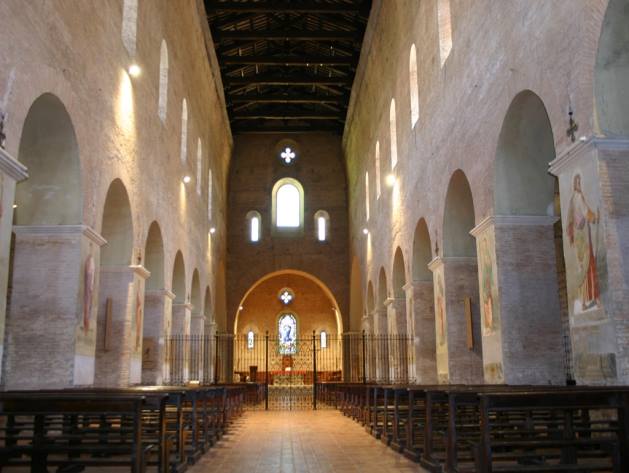
The abbey is composed of three churches, built on the site of the martyrdom. The church of Saints Vincent and Anastasius, founded by Honorius (625) and rebuilt by Honorius III (1221), is the largest of the three. Built entirely of brick, it has a high double-pitched façade and a tetrastyle portico composed of oriental marble columns and Ionic capitals. Sober and austere in appearance, the church has a Latin cross plan, with a square apse, side chapels and three naves. In the centre of the transept, in place of the dome, the naves meet through three round arches, which give access to the presbytery and the transept. To the left of the building is an ancient cloister, currently not open to visitors as it is a place of seclusion.
The church of Santa Maria Scala Coeli stands on the site where, according to tradition, over ten thousand Christian legionaries were martyred by Diocletian. Construction on the current building, commissioned by Cardinal Alessandro Farnese and designed by Giacomo Della Porta, began in 1582 and was completed in 1584.
The church, consisting of a small temple with side chapels, has an octagonal plan, surmounted by a dome and a lantern; the façade is completed by a tympanum and an oculus set in a lunette, while the door architrave features the Farnese coats of arms and, under a small tympanum, the inscription "Scala Coeli".
The interior has three apses and their altars, and houses an altarpiece by Desiderio de Angelis, which depicts the scene of the vision of Saint Bernard, and a valuable mosaic decorating the basin, executed in 1591 by Francesco Zucchi, based on designs by Giovanni de Vecchi.
Only a few traces of the ancient Cosmatesque floor that decorated the chapel remain, along with a fragment of a Christian epigraph dating back to the 3rd century. Below, the crypt opens up, housing a 16th-century altar dedicated to Saint Zeno and the Soldier Martyrs. From the two side windows, on the left, you can see a small pagan altar dedicated to the ancient Roman goddess Dia, while on the right, a small cave where, according to tradition, Saint Paul was held prisoner.
The church of San Paolo alle Tre Fontane dates back to the 5th century, but was completely remodeled by Giacomo Della Porta in 1599.
The exterior and façade are made of brick and travertine, which was used for the decorative elements of the portal, cornices, and capitals. The statues of Saints Peter and Paul, by "Franciosino", a sculptor from Lorraine, top the façade's tympanum.
From the vestibule, one enters the nave, which is transverse to the entrance, with two chapels on either side and an apse in the center. On the floor, there is a polychrome Roman mosaic from the 2nd century AD, from Ostia Antica, dedicated to the Four Seasons. Inside, there are three fountains that miraculously flowed and have been closed since 1950. They are surmounted by tabernacles by Della Porta, set within columns of black Chian marble.
The chapel altars feature paintings: on the left, on the altar dedicated to Saint Peter, a copy of Guido Reni's Crucifixion, and on the right, on the altar dedicated to Saint Paul, an altarpiece of The Beheading by Bartolomeo Passarotti. To the left of the altar of Saint Paul is the truncated column where, according to tradition, the Apostle was tied during his martyrdom.
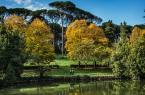
The area surrounding the abbey was formerly known as the "Acque Salvie" (Salvie Waters) and remained deserted for a long time, considered a malarial area. In 1868, the Trappist monks planted a eucalyptus grove, from which a well-known liqueur is still distilled today. Of great importance is the Three Fountains Grotto, now a popular sanctuary for pilgrims, where the apparition of the Virgin Mary occurred on April 12, 1947.
Photo credits: Church of Saints Vincent and Anastasius - Abbazia delle Tre Fontane Official Website
Information
The Abbey comprises three churches:
- Monastery SS. Vincenzo and Anastasio alle Tre Fontane
- Church of S. Maria alla Scala Coeli
- Church of S. Paolo al Martirio
The complex is open from 06.45 to 20.45
Churchopening hours
Church of Santi Vincenzo e Anastasio from 06.30 to 20.45
Church of S. Paolo al Martirio from 07.30 to 20.00
Church of Santa Maria Scala Coeli from 08.30 to 17.45
The monastery porter's lodge has the following opening hours
Monday to Saturday from 08.30 to 12.30 and from 15.00 to 18.00. 00
Sunday from 08.30 to 9.30 and from 11.00 to 12.30 p.m. and from 15.30 to 18.00.
The monastery shop is open from Monday to Saturday from 8.30 to 19.30 (non-stop), closed on Sundays
Cafe Tre Fontane is open from Tuesday to Sunday from 8.30 to 19.30 (non-stop), closed on Mondays
Schedules may be subject to change, so it is advisable to always contact the Abbey
Mass schedules
Monastery of St. Vincent and St. Anastasius at the Three Fountains
Monday: 06.45
Tuesday: 06.45
Wednesday: 06.45
Thursday: 06.45
Friday: 06.45
Saturday and public holidays: 06.45
Sunday and public holidays: 09.45
Church of Santa Maria alla Scala Coeli
Sundays and public holidays: 11.30
Church of San Paolo al Martirio
Saturdays and public holidays: 17.00
Sundays and public holidays: 11.00
 Condividi
Location
To find out about all accessibility services, visit the Rome accessible section.