












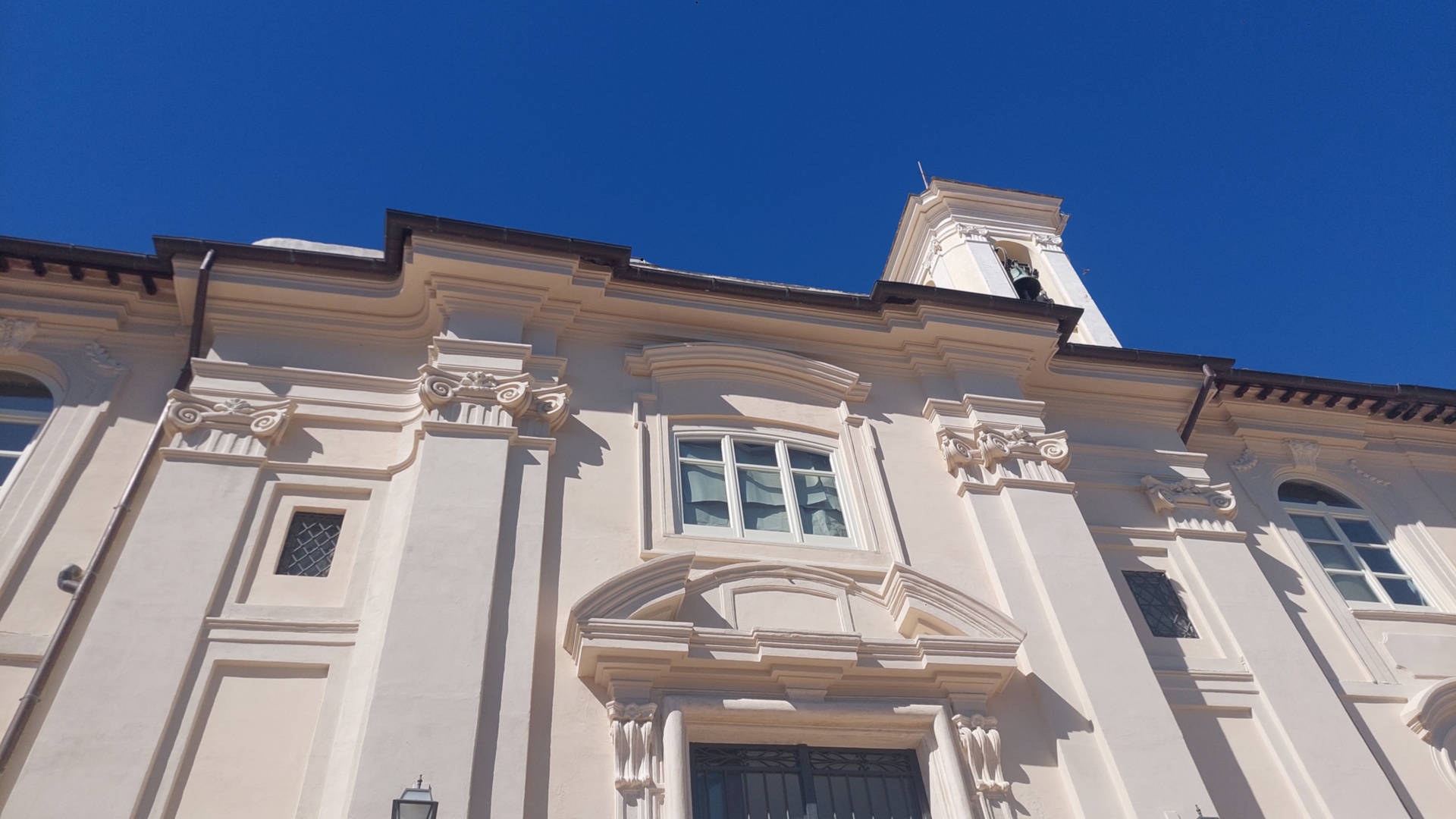
Situated in a picturesque spot almost at the summit of Monte Mario and half-hidden amongst the trees, the church’s original structure dates back to 1638, when the humanist and writer Gian Vittorio Rossi, secretary to Cardinal Andrea Peretti, had a chapel built within a vineyard he owned. A few years later, the friars of the monastery of Sant’Onofrio al Gianicolo, to whom the chapel had been bequeathed, entrusted its renovation to the architect Camillo Arcucci, a pupil of Borromini. In the early 18th century, when Pope Clement XI granted the complex to the Dominicans, the church was again restored and extended. The architect was Filippo Raguzzini, who renovated the façade and the interior. Since 1931, the adjoining convent has been home to a community of cloistered Dominican nuns.
The church is crowned by a dome and flanked by a small bell tower. The simple façade is preceded by a double flight of steps, which were added in the 19th century by Pope Gregory XVI during restoration work following the wreckage of the building due to Napoleon’s armies. A plaque commemorates Franz Liszt’s stay at the convent between 1862 and 1866, during which he composed some of his works. The interior has an elliptical plan, with a high altar and two chapels on either side. A niche with a stucco frame houses the statue of Our Lady of the Rosary. Among the valuable works preserved in the church are a 15th-century Madonna and Child by Antoniazzo Romano, a 17th-century painting by Michelangelo Cerruti depicting Saint Dominic and Saint Catherine of Siena, and a 7th-8th-century Byzantine icon – one of the oldest in Italy – which has been venerated for at least thirteen centuries.
Known as the Madonna of San Luca, as it is traditionally attributed to the evangelist, the image originated in the Syrian-Palestinian region and was initially housed in the small church of Santa Maria in Tempulo. Together with the nuns who looked after it, it was taken by St Dominic to the monastery of San Sisto Vecchio in 1221, and subsequently followed the nuns on their many moves: at the end of the 16th century, to the monastery of Santi Domenico e Sisto a Magnanapoli, and finally to Monte Mario in 1931.
The monastery houses numerous relics, including the left hand of St Catherine of Siena.
Photo Turismo Roma
Informaciones
For the timetable of the masses and visiting conditions, please consult the contacts.
 Condividi
Location
Para conocer todos los servicios de accesibilidad, visite la sección Roma accesible.