



















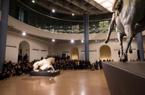











The exhibition L’Olla di Cerere e le altre. Voci, forme, complessità (The Olla of Ceres and the Others. Voices, Forms, Complexity) which opens to the public at the National Etruscan Museum of Villa Giulia, starting from one of the most significant testimonies of the language and writing of the ancient Faliscans, brings together archaeology, the study of ancient languages, and digital technologies.
At the heart of the exhibition is the Ceres Olla, named after the deity appearing at the beginning of the inscription: a precious document that allows us to analyze the earliest forms of writing in ancient Italy and gain insight into the Faliscan civilization. The exhibition presents the results of an interdisciplinary study that reexamines the text and the vessel containing it, within the broader context of Faliscan epigraphic production of the Archaic period (7th-6th centuries BC), bringing together diverse methods and expertise in a renewed interpretation of the artifact.
Since its discovery, the inscription has attracted great interest among scholars and has been the subject of numerous scholarly works aimed at explaining the forms of the language in which it is written and proposing a comprehensive interpretation of its content. However, the unique nature of the inscription, its length and complexity, combined with the fragmentary nature of the support, have made it difficult to reconstruct the text. For this reason, digital technologies were used to obtain a virtual model that would allow for the manipulation of the fragments and new interpretations. The investigations led to the surprising conclusion that the fragments are related not to a single jar, but to two different jars of identical workmanship. The possibility remains that one of the fragments may even belong to a third jar of the same type. Furthermore, the inscriptions present are an extraordinary testimony to archaic writing, within the so-called "Orientalizing period" (late 8th, first half of the 6th century BC).
The exhibition therefore aims to highlight the importance of Faliscan pottery, showcasing the ollas alongside other inscribed vases from Falerii, more or less contemporary, which were also used to support long and elaborate texts. Therefore, alongside the Ceres olla, a selection of vases and fragments broadens the scope of the linguistic peculiarities of the Faliscan area and leads the visitor to discover the forms, signs, and traces through which research reconstructs the past. The public can thus immerse themselves in the investigation thanks to two interactive tables dedicated to research methods, the languages of ancient Italy, and archaeometric analyses.
Launched in 2023, the inscription review project is promoted by the Department of Humanities at Ca' Foscari University of Venice; in collaboration with Sapienza University of Rome, through the course in Pre-Roman Italian Civilizations; the University of Bologna – Alma Mater Studiorum, with the Department of Civil, Chemical, Environmental, and Materials Engineering; CINECA – Data Visualization; and the Polytechnic University of Milan, with the Department of Chemistry, Materials, and Chemical Engineering "Giulio Natta." The National Etruscan Museum of Villa Giulia has joined the project, contributing to a journey that brings together archaeological, linguistic, scientific, and technological expertise. The initiative also benefits from the collaboration of the Superintendency of Archaeology, Fine Arts, and Landscape for the Province of Viterbo and Southern Etruria and the Regional Directorate of National Museums of Lazio, with the patronage of the National Institute of Etruscan and Italic Studies and the Municipality of Civita Castellana.
A vase and an inscription, therefore, representing a starting point for the understanding of a civilization and the rediscovering of its museum heritage.
Informaciones
Dal martedì alla domenica dalle 8.30 alle 19.30 (ultimo ingresso ore 18.30)
Lunedì chiuso
 Condividi