


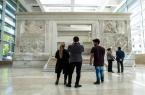














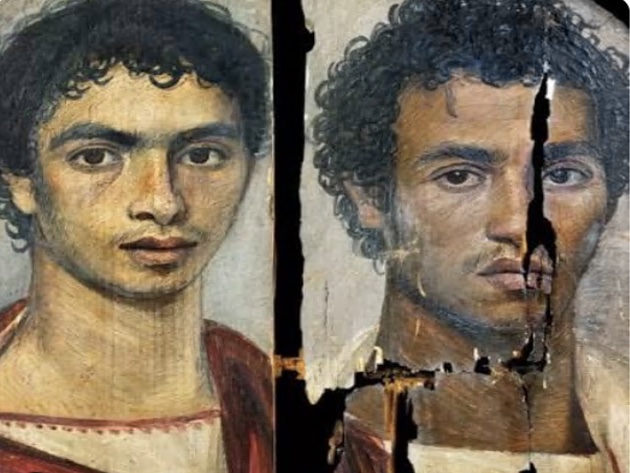
The Ara Pacis Museum hosts the major exhibition Il potere del ritratto. Egitto e Roma. I volti del Fayum (The Power of Portrait. Egypt and Rome. Faces from the Fayum), dedicated to the painted faces of Roman Egypt. Featuring over 110 works, including panels, shrouds, and funerary masks, as well as marbles, plaster casts, and ancient goldsmiths, the exhibition presents one of the most fascinating artistic expressions of antiquity, blending Roman realism with Egyptian funerary tradition. These faces, in fact, took shape in Egypt, just after the Augustan conquest, a cosmopolitan society in which Egyptian traditions, Greek culture, and Roman models intersected, contaminating and interweaving each other.
The Fayum portraits - an oasis located in the Libyan-Nubian desert southwest of Cairo - created between the end of the 1st century BC and the mid-3rd century AD in Egypt during the Roman period, are among the most famous painted images of antiquity and the rarest in Italian museums. Just under a thousand of them remain worldwide. They are wooden panels just a few millimeters thick, painted in tempera or encaustic - an ancient painting technique that involves melting colored pigments and applying them to a surface using heat over a preparation of hot wax (usually beeswax or Punic wax) - and then placed on the face of the deceased between the mummy's bandages. These are extremely delicate works, rarely loaned; the exhibition therefore represents a unique opportunity to see such a large group of them together. The Fayum Oasis was reclaimed during the early Ptolemaic Dynasty, which ruled Egypt from 305 BC to 30 BC, and became an important hub for Egyptian and Greek culture during the Hellenistic period and the early Roman Empire. Thanks to the unique climatic conditions, around 600 painted portraits have survived, offering an exceptional insight into the inhabitants who made up that human community.
Nearly 50 of these portraits are exceptionally reunited in Rome thanks to a major international loan program. For the first time, Egypt is lending nearly all of the panels held in its collections, never previously removed from the country, including the celebrated Tondo of the Two Brothers, one of the greatest masterpieces of ancient painting, restored in Egypt by Italian restorers as part of the exhibition project. The Egyptian collection is joined by twenty-three works from the Louvre, including painted panels and extremely rare linen shrouds, including those exceptionally well preserved from Antinoe (Antinopolis). Alongside these extraordinary loans, the exhibition is completed by the splendid portrait of Isidora - now at the Getty Museum - so sumptuous and refined that it has given its anonymous author the conventional name, the Master of Isidora; the portrait of Eirene from the Landesmuseum Württemberg in Stuttgart, whose name appears on the panel along with the prayer in which her loved ones entrust her soul to Osiris; the portraits from the Metropolitan Museum of Art, and a previously unexhibited youthful face, recently unearthed during excavations by the recent Italian archaeological mission in Egypt led by the University of Salento.
The exhibition is divided into five sections. The first explores the origins of the need to pass on those faces, through the extremely rare collection of casts from the Tomb of the Valerii under St. Peter's, which document the entire process: from the imprint taken of the deceased's face to the commemorative marble. The second represents the meeting point between the two traditions: in Roman Egypt, the mask gives way to the painted panel, while the funerary rite maintains its continuity. The sarcophagus with the mummy of the little girl Giupra, from the National Archaeological Museum of Florence, reminds us that those portraits accompanied and identified a real person. The third is the Hall of Faces: dozens of panels from the Fayum, each with a name and a story - Demos and his little girl, a mother and daughter kept in the same tomb, the proud soldier from the Eton College collection - are juxtaposed with sculpted portraits from the Capitoline collections. The exhibition also includes a comparison with the jewels from Pompeii and Herculaneum, which allow us to recognize some of the ornaments depicted in the paintings in the reality documented by the excavation. The fourth section delves into the subject matter of portraits: encaustic and tempera, the various types of wood worked into millimeter-thick panels, the edges cut to fit into bandages, linen, stucco, and marble. The fifth concludes with some of the last painted panels, dating to the 3rd century AD, and the large, precious shrouds from Antinoe (Antinopolis) - a city founded in 130 AD by Emperor Hadrian in honor of Antinous - where the funerary face does not disappear, but is transformed, and the memory of the deceased thus continues to find new forms.
The exhibition is curated by Claudio Parisi Presicce and Laura Petacco, promoted by Roma Capitale, Department of Culture and Coordination of initiatives related to Holocaust Remembrance Day, Capitoline Superintendency of Cultural Heritage, organized by the Capitoline Superintendency and the RTI MondoMostre – Civita Mostre e Musei, with the support of Zètema Progetto Cultura.
Informaciones
Dal 5 novembre 2026 al 2 maggio 2027
Tutti i giorni 9.30-19.30. Ultimo ingresso un’ora prima della chiusura
24 e 31 dicembre 9.30-14.00 (ultimo ingresso ore 13.00)
Giorni di chiusura: 1° maggio e 25 dicembre
 Condividi