













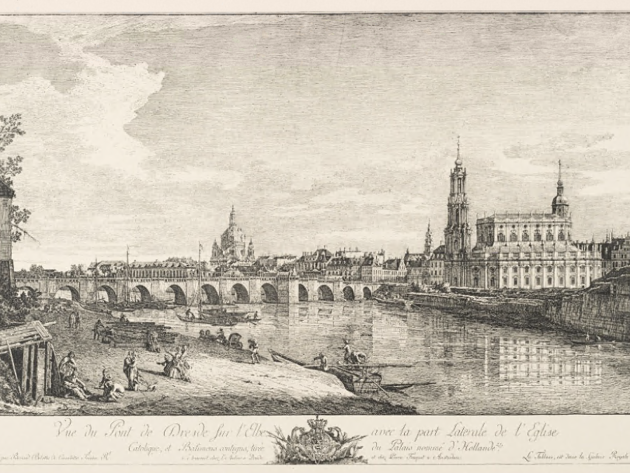
From 25 September 2026 to 10 January 2027, the Napoleonic Museum hosts the exhibition Il barocco italiano a Dresda (Italian Baroque in Dresden), a selection of drawings and sketches by Italian and Saxon artists, considered masterpieces of 18th-century European architectural design, present in the scientific collection of the Landesamt für Denkmalpflege Sachsen (Regional Office for the Protection of Cultural Heritage of Saxony).
In the mid-18th century, Dresden - the capital of Saxony, known as "Florence on the Elbe" for its wealth of art treasures - became one of the leading centers of Italian culture north of the Alps, under the reign of Prince-Elector Friedrich August II (King of Poland as August III) and his wife Maria Josepha. Passionate about Italy and "opera seria," the royals not only collected masterpieces of Italian painting, such as those by Raphael, Correggio, Giorgione, and Titian, but also attracted numerous masters of the Bel Paese to Dresden, including composers, singers, instrumentalists, painters, stucco workers, musicians, dancers, poets, set designers, and theater architects, drawn by the splendor of a new "Augustan Age". Among these, the court painter Bernardo Bellotto, known as Canaletto, originally from Venice, stands out. His magnificent views uniquely capture the city's appearance at the time. At the same time, scholars, painters, and architects from Dresden undertook study trips to the South, some of which were long-term, bringing their impressions back home, resulting in highly fruitful cultural exchanges. Among these, the court painter Bernardo Bellotto, known as Canaletto, originally from Venice, stands out. His magnificent views uniquely capture the city's appearance at the time. At the same time, scholars, painters, and architects from Dresden undertook study trips to the South, some of which were long-term, bringing their impressions back home, resulting in highly fruitful cultural exchanges.
The exhibition is divided into four rooms: the first, entitled Rome as a Model, features a presentation of the city of Dresden, as well as six drawings of interior details from the Roman churches of Sant'Ivo alla Sapienza, San Carlo alle Quattro Fontane, and Ss. Trinità dei Monti, as well as the Villa Albani. Two other particularly large drawings are the work of the future Saxon chief architect Julius Heinrich Schwarze, who copied Filippo Juvarra's famous design for a domed church in Rome and adapted it for his own church project in Dresden.
The second room is dedicated to the construction of the new Catholic court church in Dresden, designed and built by the Roman architect Gaetano Chiaveri. In addition to eight drawings by Chiaveri and other architects involved in the project, the room's main work is the color drawing of the altar of the Annunciation in Sant'Ignazio, created by the circle of Anton Raphael Mengs, which was intended to serve as a model for an altar in Dresden.
The third room is also dedicated to Gaetano Chiaveri, with a total of ten drawings, some of extraordinarily large formats, representing plans for a new royal palace for the Prince Elector of Saxony in Dresden.
Finally, the fourth room is entitled Italians in Dresden, which displays twelve drawings of architectural and artistic decorations by Italian artisans and artists who had been invited to the Saxon capital. Particularly noteworthy are Giuseppe Galli Bibiena's designs for the ceiling decoration of the Catholic court church, including a design by Giovanni Antonio Pellegrini for his pictorial decorations in the Dresden Zwinger, considered the master's largest known drawing.
The exhibition therefore offers a glimpse of that extraordinarily culturally fertile era, to which Dresden primarily owes its fame, which still endures today, as a city of art and music.
Photo:
Informaciones
dal 25 settembre 2026 al 10 gennaio 2027
Da martedì a domenica ore 10.00 - 18.00 (ultimo ingresso ore 17.15)
24 e 31 dicembre ore 10.00 - 14.00 (ultimo ingresso ore 13.15)
Giorni di chiusura: Lunedì e 25 dicembre
CONSULTA SEMPRE LA PAGINA AVVISI prima di programmare la tua visita al museo
 Condividi