





















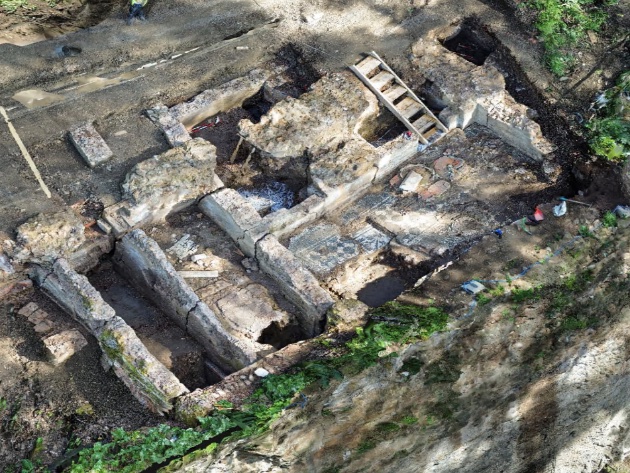
As part of the PNRR (National Plan for the Protection of Cultural Heritage), the Ministry of Culture's Special Superintendency of Rome has brought to light eight rooms of an imperial-era building at Villa Celimontana, decorated with frescoes and mosaics of great value. The project began with the consolidation of the ancient wall that supports the slopes of the plateau of the sixteenth-century Villa Mattei, starting from Campo Celimontano at its foot; this wall was found to actually consist of two adjacent walls.
Excavations above the innermost wall revealed a 2nd-century AD building in opus lumber, with alterations in opus listatum and a different spatial distribution starting from the 3rd century. It was located exactly where the 17th-century loggia of Villa Mattei, facing San Sisto, once stood. Its foundations were found, firmly anchored to the Roman walls beneath.
These include five completely excavated rooms and three others partially preserved, but the complex extended well beyond in the direction of Villa Mattei, where both the presence of monumental cypress trees and the financial limitations of the project prevented its complete excavation.
Among the most significant finds are a large mosaic with a marine emblem depicting a dolphin, a fish, a lobster and a crab around a crater, fragments of an earlier mosaic floor from the Antonine period, large portions of the frescoed ceiling and numerous opus sectile coverings, evidence of the complex's high decorative level.
The nature of the building remains under study and raises a fascinating interpretative question: the refined mosaics and frescoes appear to tell the story of an aristocratic residence, while the building's location and some elements discovered during the excavation could indicate that it was part of the barracks of the 5th Cohort of the Vigiles. If this second hypothesis is confirmed, the discovery would help redefine the extent of one of the most important military complexes of Imperial Rome.
Only a thorough study of the excavation materials and the structures uncovered will provide further information on the newly discovered structure.
Foto: Press release
 Condividi