




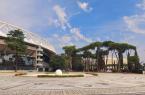



















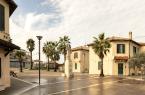
Amidst holm oaks and cypresses, two twin fountains adorn and enhance a small, elliptical, pedestrians-only square, which today has all the charm of a peaceful and welcoming open-air lounge. The small square, named after the Mannerist painter Perin del Vaga (a pupil of Raphael), was built between 1925 and 1927 alongside the large ICP Flaminio II housing complex that overlooks it, designed by the architects Tito Bruner, Mario De Renzi, Alessandro Limongelli and Giuseppe Wittinch for the Istituto Case Popolari (Institute for social housing).
The urban development of this area – nestled within the great bend of the Tiber – had begun just a few years earlier, in 1909, with the Master Plan drawn up by the engineer Edmondo Sanjust di Teulada under the administration of Mayor Ernesto Nathan, which marked the beginning of the modern history of the Flaminio district. From its very inception the district has been a place of architectural and urban experimentation, from the monumental “Palazzo delle Ancore” of the Ministry of the Navy to the Villaggio Olimpico, from the Auditorium Parco della Musica Ennio Morricone to MAXXI - Museo Nazionale delle Arti del XXI secolo and the Ponte della Musica, inaugurated in 2011.
Innovation and the search for new solutions also characterize the beautiful complex overlooking the small square. By breaking with the rigidity and uniformity of the nineteenth-century grid (the blocks along the streets of Prati, for example), Bruner, De Renzi, Limongelli and Wittinch designed original and varied residential layouts with greater compositional freedom in the organization of interior spaces and in the relationship between the street and the courtyard. Architectural details (of the entrance doors, balconies, cornices, roof terraces and dormer windows…) draw on the tradition of Roman “Barocchetto”, with elements reminiscent of the vernacular architecture of the late sixteenth century.
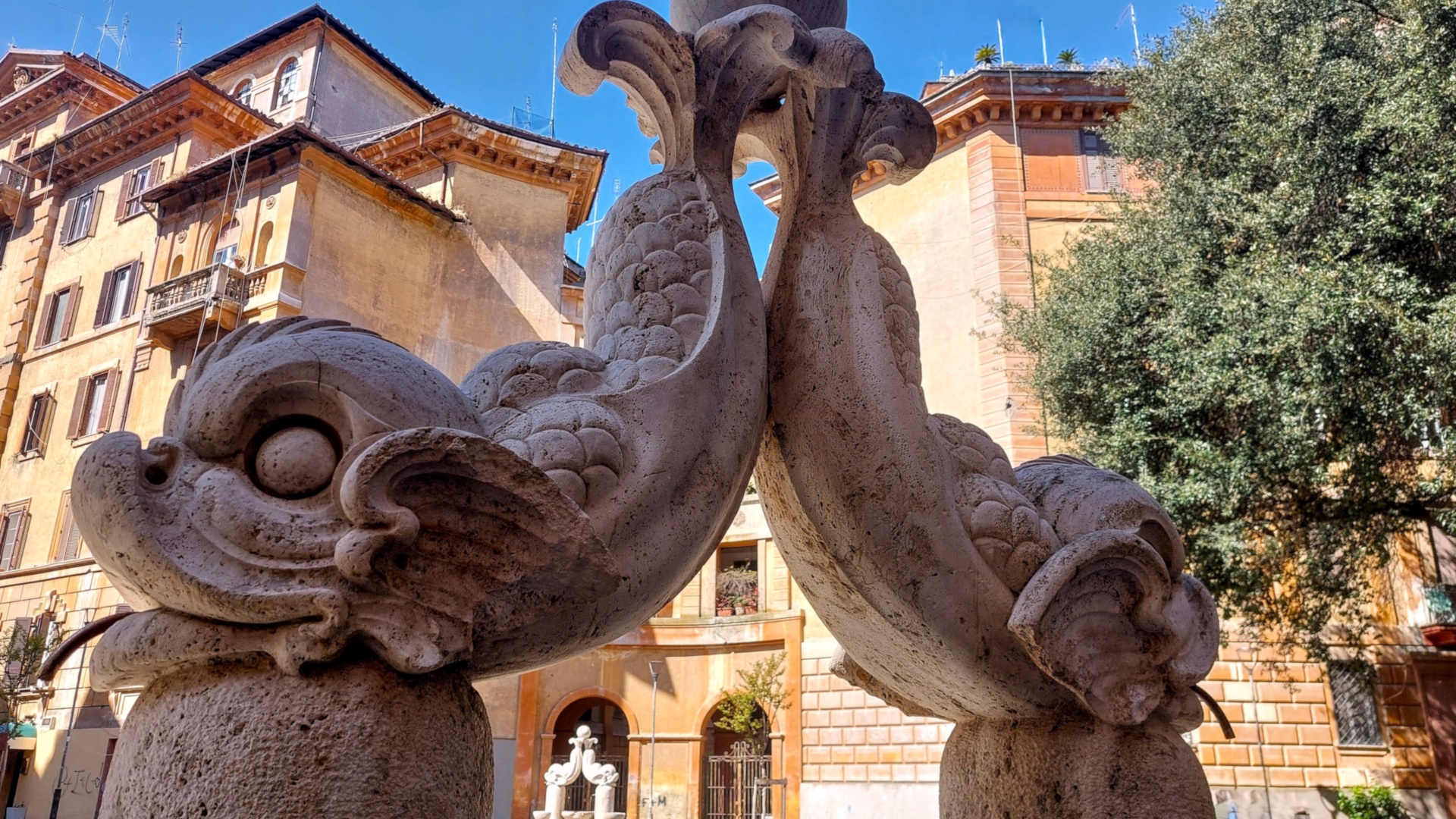
The placement in the square of the two symmetrical fountains contributes to the sense of unity sought by the designers; these draw the passer-by’s attention towards the monumental entrance to the central building and to the inscription, high above the entrance, “ISTITUTO PER LE CASE POPOLARI”. In each fountain, a travertine dolphin supported by a small pillar plays with a ball resting on its raised tail, spraying water into two of the three basins below. Owing to their style and the clear references to the nearby River Tiber, the two fountains are reminiscent of those created in the same period by the architect and sculptor Pietro Lombardi, which are scattered throughout the “Rioni” of Rome.
Photo Turismo Roma
Informaciones
 Condividi
Location
Para conocer todos los servicios de accesibilidad, visite la sección Roma accesible.