






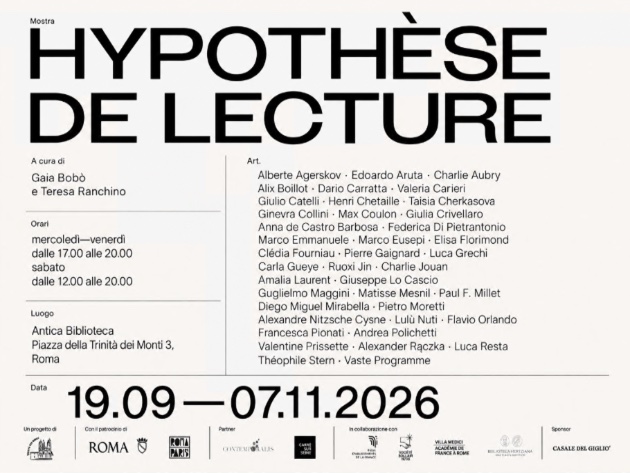
Trinità dei Monti opens the spaces of the Ancient Library to the public, part of the Complex finally open to the public after extensive restoration. The space opens with the exhibition Hypothèse de lecture, curated by Gaia Bobò and Teresa Ranchino.
The exhibition presents a selection of Italian and French artists, with a particular attention on the contexts of Rome and Paris and emerging research. This exhibition represents a new cultural direction for Trinità dei Monti, encouraged by director Marie-Pierre Dabadie, who has decided to reopen this historic venue with a contemporary art exhibition.
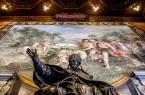
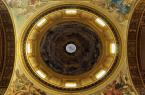
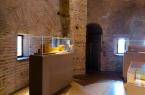
Located above the altar of the church of Trinità dei Monti, one of five French churches in Rome belonging to the Pieux Etablissements de la France à Rome et à Lorette, the ancient library of the Minim convent housed approximately nine thousand volumes until the end of the 18th century. The space, now empty, is decorated with one of the most monumental painted wooden ceilings in the city. The dispersion of the library's collection in 1798 and the damage suffered during the revolutionary events deeply affected its history. A major restoration project, undertaken starting in 2003 in collaboration with the Vatican Museums laboratories, has finally returned the library to its exceptional decorative apparatus, making its historical and artistic value once again visible.
The exhibition is conceived as a tribute to the history of this place, reflected in the choice to construct a phantom architecture, inspired by a library and conceived by Belgian architect Olivier Goethals. This is, in fact, the "reading hypothesis", born from the desire to imagine a rewriting of the irretrievable loss of the library's written texts and collection, filling a void that the works of the invited artists reinterpret in an imaginative way.
Drawing on these insights, the works resonate with the history and identity of the site through various aspects: their relationship with the processes of memory loss and dispersion; the relationship between word and image, with a focus on the investigation of writing practices and literary influences; and the dimension of destruction and fragmentation, which, harking back to the concept of spolia, takes on a particular significance in the context of Rome's archaeological stratification. The exhibition also seeks to highlight Baroque aesthetics in contemporary creation, evoking the processes of metamorphosis of matter and the body, as well as the use of specific aesthetic devices.
The exhibition is accompanied by a comprehensive public program of meetings and conferences, developed in collaboration with the Bibliotheca Hertziana – Max Planck Institute for the History of Art, the French Academy in Rome – Villa Medici, and the Società delle Api.
The exhibition is promoted by Trinità dei Monti, with the patronage of Roma Capitale, and is part of the anniversary program of the twinning between Rome and Paris, 70 ans d’amitié — 70 years of twinning.
The exhibition is supported by CONTEMPORALIS Association Amis Art Contemporain France-Italie, in partnership with Carrè sur Seine.
Photo: official poster of the exhibition
Informationen
Dal 19/09/2026 al 09/11/2026, tutti i giorni
 Condividi