


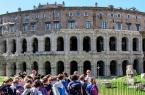




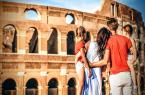


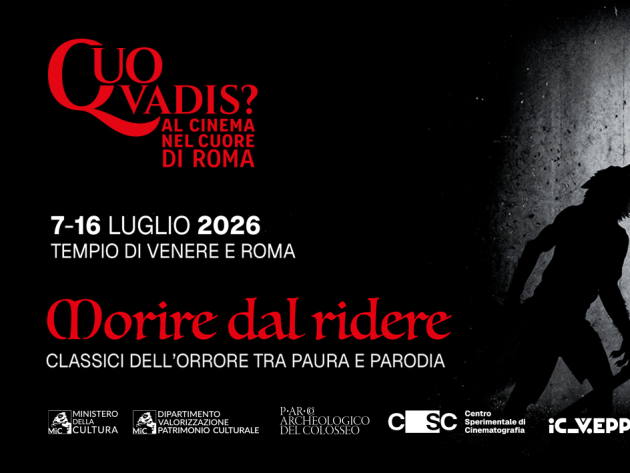
From July 7th to 16th, the film festival QUO VADIS? At the cinema in the heart of Rome, promoted by CSC – Cineteca Nazionale and the Colosseum Archaeological Park, returns to the Temple of Venus and Rome. The event, now in its fifth year, is titled Die of laughter . Horror Classics: Between Fear and Parody. and explores some of horror cinema's most powerful and timeless images, including expressionist shadows, castles shrouded in fog, mad scientists, and creatures on the fringes of humanity. The program ranges from silent film and Universal Pictures masterpieces to auteur reinterpretations and the irresistible parodies that have reinvented the imagination, offering a journey through fear as an artistic, spectacular, and, above all, cinematic form.
Alongside classics such as the monstrous and disturbing vampire of Nosferatu (1922) by Friedrich Wilhelm Murnau, or the tragic creature of Frankenstein (1931) by James Whale and the painful and scandalous world of Freaks (1932) by Tod Browning, which defined the aesthetics of horror on the big screen, transforming the monstrous into a mirror of our deepest fears, the exhibition offers other more recent famous masterpieces such as Young Frankenstein (1974) by Mel Brooks, an extraordinary comic homage to Universal's horror cinema, or The Fearless Vampire Killers (1966) by Roman Polanski, where the vampire becomes the subject of elegant and surreal satire. The myth of Dracula then returns in the visionary and romantic dimension of Werner Herzog's Nosferatu the Vampyre (1979), an auteur remake that transforms horror into a melancholic meditation on solitude and death. The journey also includes European and Italian Gothic with Histoires extraordinaires (1968) by Roger Vadim, Louis Malle, and Federico Fellini, a free homage to Edgar Allan Poe, and with con L’orribile segreto del dottor Hichcock (The Horrible Secret of Dr. Hitchcock) (1962) by Riccardo Freda, a refined and morbid example of 1960s Italian Gothic. Ideally closing this journey into the uncanny is Dario Argento's Opera (1987), a visionary pinnacle of the Italian horror-thriller, where the gaze itself becomes an instrument of obsession and violence. Dario Argento himself will introduce the film on the evening of Tuesday, July 14th. This will be followed, on July 16th, by a screening of Giovanni Pastrone and Luigi Romano Borgnetto's La caduta di Troia (The Fall of Troy) (1911), with a live score by Maud Nelissen, a Dutch composer and pianist who has dedicated herself entirely to creating music for silent films. The film is part of the major exhibition Troy and Rome: Myths, Legends, Stories of the Ancient Mediterranean, running from June to November 2026 at the Colosseum Archaeological Park.
For the complete program, please visit the official website: https://colosseo.it/evento/quo-vadis-2026/
Photo: official poster of the event
Informationen
Da martedì 7 a giovedì 16 luglio 2026Accesso da Piazza del Colosseo dalle ore 20.00
Introduzione ore 20.45, inizio proiezioni ore 21.15
 Condividi