



















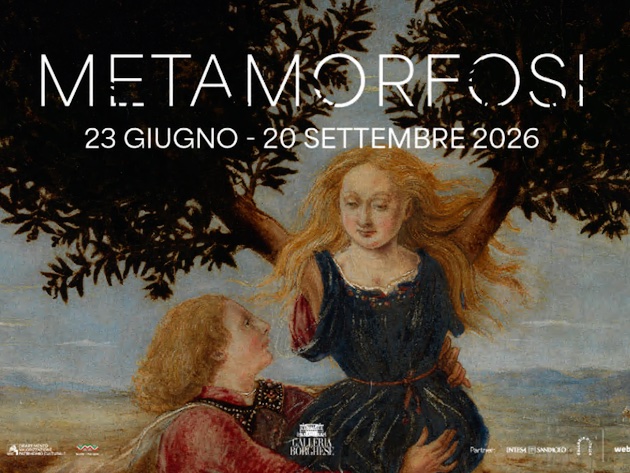
The splendid halls of the Galleria Borghese host the major exhibition project, curated by Francesca Cappelletti and Frits Scholten, entitled Metamorfosi. Ovidio e le arti (Metamorphosis: Ovid and the Arts), a collaboration with the Rijksmuseum in Amsterdam.
The exhibition in fact, which is centered around Publius Ovidius Naso's Metamorphoses (43 BC–17 AD)—one of the foundational and most enduring texts of the Western imagination—explores the theme of metamorphosis as a universal generative principle and a key to understand the cosmos, matter, and the human condition. Ovid's poem thus offers a vision of the world grounded in change, the instability of forms, and the permeability of the boundaries between the human, the natural, and the divine.
Through famous myths and tales, the Metamorphoses has offered artists an inexhaustible repertoire of images for centuries, giving visual form to passions, desires, but also to violence and deception. The exhibition thus highlights a universe in which gods, humans, and nature share a destiny of continuous transformation. Alongside themes dear to Ovid, such as Love, the Afterlife, and the Creation of the World, the exhibition also explores the phenomenon of Ovide moralisé, a medieval rewriting of the work, which strongly influenced representations of myths during the Renaissance.
The spaces of the Galleria Borghese also offer a privileged context for this exhibition, as the very foundation of the Villa “fuori Porta Pinciana” has its roots in the symbolic universe of the Metamorphoses, making this location not only suitable, but intrinsically linked to the theme of the exhibition. Cardinal Scipione Borghese built the Casino Nobile to house part of his collection, conceiving architecture as a cultural device capable of intertwining myth, art, and self-representation into a single, coherent system of meanings.
The exhibition covers a time span from masterpieces by the great Renaissance and Baroque masters such as Correggio, Michelangelo, Titian, and Rubens, to Classicist artists such as Poussin, to artists from more recent eras such as Gérôme, Rodin, and Brancusi, showing the full visual power and allure of Ovid's tales. Particularly around Gian Lorenzo Bernini's Apollo and Daphne and Pluto and Proserpina, and the Gallery's other mythological masterpieces, the exhibition reaffirms the actuality of myth and its central role in the construction of the European imagination.
Produced in collaboration with the Rijksmuseum, the exhibition catalogue – available in Italian, English and Dutch – presents all the works on display at the two venues and includes essays by Italian and Dutch scholars.
Photo: official poster of the exhibition
Informationen
dal martedì alla domenica dalle 9.00 alle 19.00Ultimo ingresso alle ore 17.45Mostra prorogata fino all'11 ottobre 2026
 Condividi