







Organised by the Department of Culture of Roma Capitale and Azienda Speciale Palaexpo, curated by Guido Bellachioma and with a layout designed by THREES (the organisation that devised the international music festival Terraforma), the exhibition at Palazzo Esposizioni recounts Rome in the 1970s, when the city became an exceptional crossroads of artists, ideas, revolutionary languages and sounds that spread throughout Italy while engaging with the rest of the world.
The 1970s were a vital and complex decade that saw music transcend its own aesthetic conventions to merge with literature, counterculture, painting, cinema and theatre, acting as a powerful catalyst for collective identities, in an era marked by the expansion of the recording industry and the pioneering advent of free radio stations. In this context, musical expression became fertile ground for the convergence of art and politics and the driving force behind cultural and social transformations. Rome was at the heart of this metamorphosis, flanked by cities of equal significance such as Milan, Naples and Bologna, and by smaller but by no means marginal centres such as Viterbo, Nettuno and Zerbo, in the province of Pavia.
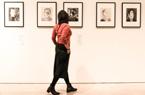
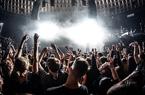
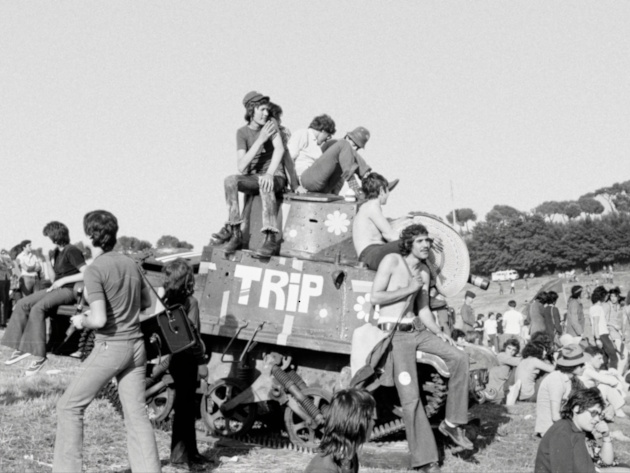
The exhibition presents to the public materials and documents relating to the leading players of the time, from Francesco De Gregori to Antonello Venditti, Rino Gaetano, Renato Zero, Lucio Battisti, Franco Battiato, Mia Martini, David Bowie, Patti Smith, Miles Davis, Genesis, Pink Floyd and the Rolling Stones. Around seven hundred photographs, most of them previously unpublished, capture the artists’ creativity in the studio and during performances, as well as the spontaneous atmosphere of the squares, and are accompanied by posters, concert tickets, music magazines, fanzines, leaflets, books, vinyl covers and musical instruments. A soundtrack updated every two weeks accompanies visitors along the exhibition route: three hundred selected tracks ranging from rock-blues to singer-songwriter music.
Cover: Tank Trip, Villa Pamphilj Festival, Rome, 25–27 May 1972 © Giovanni Coccia
Informationen
Dal martedì alla domenica dalle ore 10.00 alle 20.00
L'ingresso è consentito fino a un'ora prima della chiusura
 Condividi