




















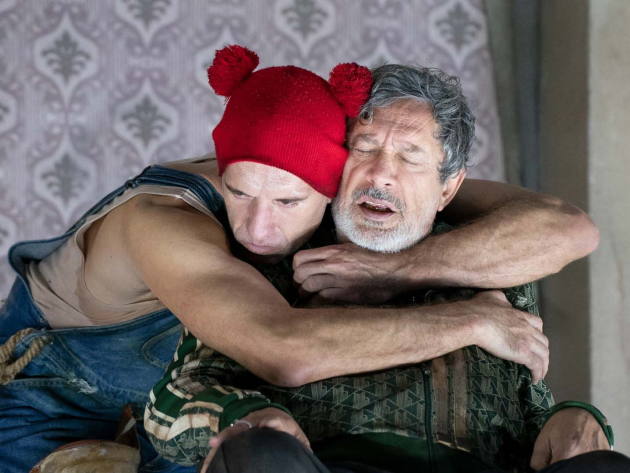
One of the most iconic works of Samuel Beckett's "theatre of the absurd" and of 20th-century theatre as a whole returns to the stage at the Teatro India in an original interpretation by director Gabriele Russo. The one-act play, originally written by Beckett in French under the title Fin de partie, was later translated into English by the author himself as Endgame and published in 1957.
The drama's protagonists are Hamm, a blind and infirm elderly man confined to a wheelchair, and his servant Clov, who, unlike Hamm, due to some strange illness, cannot sit and is therefore forced to stand constantly. The two characters eke out an existence in a small house by the sea, along with Hamm's elderly parents, Nagg and Nell, who have no legs and live inside two garbage cans in the left foreground of the scene. From the dialogue, however, one gets the impression that nothing outside actually exists: the exterior seems to have been destroyed by some unspecified catastrophe.
The title is inspired by the term used to describe the final phase of a chess game when only a few pieces remain on the board. Beckett, who was known to be a chess enthusiast, and Hamm's refusal to accept the impending end, can be compared to that of chess players in the final stages of a game. This strange and unlikely situation in which the four characters live seems to be about to come to an end, as the title of the play suggests: Clov intends to leave this sort of bunker, leaving only Hamm, who has lost both his parents during the course of the play and has accepted their deaths peacefully. Hamm, moreover, seems to accept Clov's departure with complete indifference, as it is part of the "game."
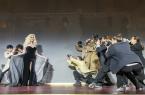
The play at the Teatro India offers a different reading, updating the text, as today, after the collective trauma of the pandemic, the meaning of this segregation takes on new nuances.
Translated by Carlo Fruttero; directed by Gabriele Russo; starring: Michele Di Mauro, Alessio Piazza, Giuseppe Sartori, Anna Rita Vitolo.
Photo credits: Flavia Tartaglia
Informations
 Condividi